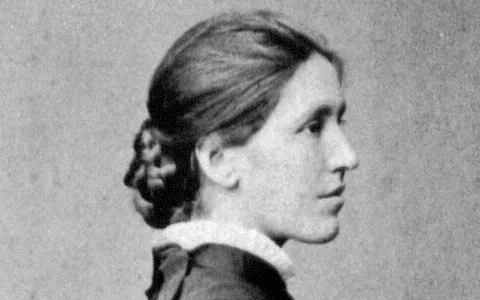


There is often a perception that many employees of wildlife organisations have little knowledge of, or engagement with, the history and founding principles of the movements they represent. A striking example came during the recent centenary commemorations of the League Against Cruel Sports, when an incorrectly identified photograph of one of the organisation’s co-founders went unnoticed by staff and trustees alike.
Against this backdrop, it is especially encouraging to encounter those who do take a serious interest in the heritage of conservation and animal protection. One such figure is Conor Mark Jameson, who spent 25 years working for the Royal Society for the Protection of Birds at its headquarters, The Lodge, in Sandy, Bedfordshire.
In an interview with Sarah Stott for Pelagic Publishing, Jameson explained that his fascination with W.H. Hudson began with the life-size oil portrait of Hudson that hangs at the RSPB headquarters. The more he learned about Hudson, the more perplexed he became that such an influential figure had faded into relative obscurity.
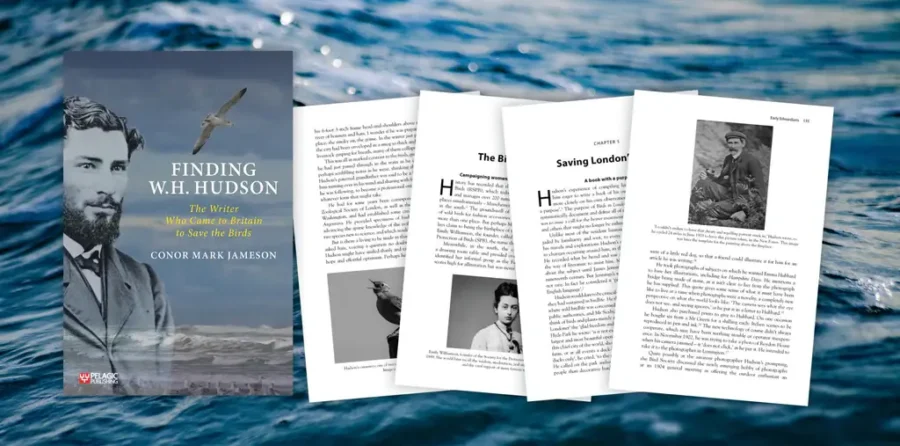
Jameson’s recent book, Finding W.H. Hudson, is described by the author as “a process of restoration”, piecing together Hudson’s life through his letters, his relationships with the pioneers of conservation, and his remarkable campaigning work after arriving in Britain from Argentina at the age of 33. Drawing on his own experience in natural history, conservation and public communication, Jameson seeks to restore Hudson to his rightful place in the history of wildlife protection.
He was particularly struck by the extent of Hudson’s activism. Far from being simply a solitary nature writer, Hudson campaigned vigorously for bird protection at both local and national level and was actively involved in efforts to preserve London’s green spaces, including a major campaign to protect part of Kew. Jameson also highlights the remarkable range of famous figures who admired Hudson, despite his lifelong social anxiety and preference for solitude and the company of ordinary rural people.
Finding W.H. Hudson traces the unassuming field naturalist’s path through a dramatic and turbulent era: from Hudson’s arrival in Britain from Argentina in 1874 to the unveiling, fifty years later, of a monument and bird sanctuary in his honour in the heart of Hyde Park by the prime minister — close to the place where the young immigrant had once slept rough.
At its heart, this extraordinary story explores Hudson’s profound influence on the founding women of his beloved Bird Society and on the wider rise of the conservation movement. It reveals the strange magnetism of this mysterious man from the Pampas — unschooled, battle-scarred and once penniless — whose character and convictions left a lasting impression on all who knew him.
A century after Hudson’s death, Finding W. H. Hudson stands as a long-overdue tribute to one of Britain’s most significant — and most neglected — writer-naturalists and wildlife campaigners.
Discover more about Finding W.H. Hudson here
Finding W.H. Hudson – Conor Mark Jameson’s Interview here
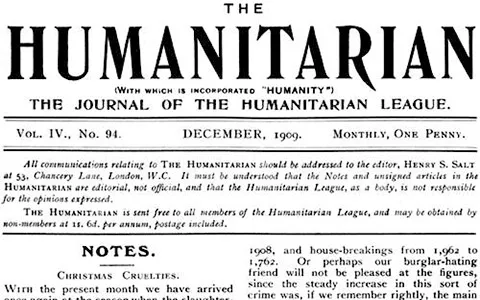
Henry Salt and W.H. Hudson by Conor Mark Jameson here
W.H. Hudson Profile by Conor Mark Jameson here