

Can anyone help establish the parentage of the Rev. Frederick Needham, rector of Tunstall, Lancashire?
One of the intriguing genealogical problems surrounding the Möller family concerns Anne Möller, who married the Rev. Frederick Needham in Dublin in 1805. Anne was the daughter of Andrew Möller of Butterston, and she is therefore of particular interest to students of the Möller family and, through her descendants, to the family history of Henry S. Salt, the writer, humanitarian and reformer.
The existing account of the Möller family on this website records that Andrew Möller’s daughter Anne married “Rev. F. Needham, rector of Tunstal, Lancashire” and had issue.
The identity and background of her husband, however, present an intriguing problem. There is strong evidence that the Rev. Frederick Needham was connected by blood to the wealthy North family of Westmorland and Lancashire, and in particular that he was probably the paternal half-brother of Richard Toulmin North, the proprietor of Thurland Castle and patron of the living of Tunstall.
The evidence is substantial, but one crucial document has so far eluded discovery. This article sets out what is currently known in the hope that another researcher may be able to identify the missing link.
The Rev. Frederick Needham of Tunstall
Frederick Needham was born about 1771. He subsequently entered the Church of England and became rector of Tunstall in Lancashire, where he was in office from approximately 1810 to 1816.
He married Anne Möller in Dublin in 1805. Their son Frederick Charles Needham was born in 1806, and the couple had five children.
The Tunstall parish registers provide independent evidence for the family. On 1 January 1814, for example, William Walter Needham, son of Frederick Needham and Anne, was baptised at St John the Baptist, Tunstall. Frederick is described as “Vicar of Tunstal.”
The registers also show Frederick actively performing his clerical duties in the parish. In 1813 he was officiating at marriages as vicar of Tunstall.
After Frederick’s death, his widow Anne and their children appear to have remained connected with the North family and the Tunstall area.
It is the fate of their eldest son, Frederick Charles, which provides one of the most remarkable pieces of evidence.
Richard Toulmin North and the “half-brother”
In August 1826, the Liverpool Mercury reported a court case involving Richard Toulmin North.
The newspaper described North as a gentleman with interests in Yorkshire, Lancashire and Ireland, proprietor of Thurland Castle, and proprietor of the rectory of Tunstall.
It then made a remarkable statement about Frederick Needham:
“the person who formerly held the rectory (Rev. Frederick Needham) was half-brother of Mr. North”
The newspaper went on to explain that Frederick Needham had married an Irish lady, Anne Moller, and that after Frederick’s death Anne came to England with her son, Frederick Charles Needham.
North eventually took an interest in the boy, regarding it as his duty to assist “the eldest son of his deceased brother.” He attempted to send Frederick Charles to St Bees School in Cumberland and, when this proved impossible, the boy was taken into the North household at Thurland Castle.
This contemporary account is the reason for the investigation described here.
If the newspaper is correct, Frederick Needham and Richard Toulmin North were half-brothers.
But how?
Their surnames were different, and the surviving genealogical material initially gives no obvious explanation.
The answer appears to lie in the previous generation.
Miles North and Elizabeth Needham of Dublin
The crucial evidence comes from the will of Miles North of Kirkby Lonsdale, dated 26 November 1784.
Miles North was the father of Richard Toulmin North.
His will contains an extraordinary provision:
“Mrs. Elizth. Needham, of Dublin”
was to receive an annuity of 100 guineas for life.
The will then provided for:
“her son Frederick Richard Needham”
who was to receive £100 a year until he reached 21 and £200 a year thereafter for life.
After Frederick’s death, £100 a year was to be paid to his children during their joint lives and the life of the survivor.
Most significantly, the will states that these payments were to be made “out of my estates in Ireland.” The Irish executor appointed by Miles North was Croasdaile Molony of Dublin.
This document is the key to the whole mystery.
It establishes beyond reasonable doubt that:
- There was an Elizabeth Needham living in Dublin.
- She had a son named Frederick Richard Needham.
- Miles North considered both Elizabeth and Frederick sufficiently close to him to provide them with substantial lifetime financial support.
- The provision was charged upon his Irish estates.
- Croasdaile Molony of Dublin was responsible for the Irish side of the estate.
The identity of Frederick Richard Needham with the later Rev. Frederick Needham of Tunstall is not explicitly stated in the will, but the age, name and subsequent history make the identification highly compelling.
Why this suggests that Frederick was Miles North’s son
There is an important chronological consideration.
Miles North married Susanna Toulmin in 1778.
Their son Richard Toulmin North was born in 1782.
Frederick Richard Needham, however, was born about 1771—approximately seven years before Miles North’s marriage to Susanna.
The simplest explanation is therefore that Frederick was Miles North’s son by Elizabeth Needham, born before Miles’s marriage to Susanna Toulmin.
If so, Frederick retained his mother’s surname, Needham, while Richard Toulmin North bore his father’s surname.
This would make the relationship:
Miles North
├── Frederick Richard Needham, c.1771
│ probably by Elizabeth Needham of Dublin
│
└── Richard Toulmin North, 1782
by Susanna Toulmin
Frederick and Richard would therefore have been paternal half-brothers.
This is not yet proven by an explicit statement of parentage, but it fits the surviving evidence remarkably well.
The Dublin Chancery case of 1796
There is another extraordinary piece of evidence.
On 28 June 1796, the Dublin Evening Post reported a Chancery case in which the plaintiffs were:
“Eliz. Needham and Frederick Rich. Needham”
and one of the defendants was:
Richard Toulmin North, described as a minor of about fifteen.
At first sight this might seem merely coincidental.
It becomes much more significant when the remainder of the newspaper notice is considered.
A subsequent advertisement states:
“Pursuant to an order made in this cause, in his Majesty’s High Court of Chancery of Ireland…”
it was ordered that the lands of Marvelstown, in the county of Meath, should be let to the highest bidder during the minority of Richard Toulmin North.
The notice was dated 25 April 1796 and directed enquiries to Croasdaile Molony, Esq., Abbey-street, Dublin.
This is potentially the missing link.
Why Marvelstown matters
Marvelstown was one of the Irish properties associated with the North family.
The connection to Miles North is particularly important because his 1784 will specifically provided for Elizabeth Needham and Frederick Richard Needham from his Irish estates. TThe Silver Bowl
Croasdaile Molony was named as Miles North’s Irish executor.
Yet ten years later, in the 1796 Chancery proceedings, Croasdaile Molony again appears as the Dublin contact in a case involving:
- Elizabeth Needham;
- Frederick Richard Needham;
- Richard Toulmin North;
- and Marvelstown, a North family estate.
This is an extraordinary concentration of names and circumstances.
The most plausible explanation is that Elizabeth and Frederick were asserting or protecting rights arising from Miles North’s estate, possibly the financial provisions made for them under his will.
That remains a hypothesis until the underlying Chancery proceedings are located.
A possible reconstruction of the 1790s
The sequence may have been something like this:
1784 — Miles North makes his will. He provides substantial annuities for Elizabeth Needham of Dublin and her son Frederick Richard Needham, to be paid from his Irish estates. TThe Silver Bowl
1795 — Miles North dies. His will is proved at York.
1795–1796 — Richard Toulmin North, Miles’s legitimate son, becomes entitled to the North estate but is still a minor.
1796 — Elizabeth Needham and Frederick Richard Needham become involved in proceedings in the Irish Court of Chancery against Richard Toulmin North.
April/May 1796 — The Court orders that Marvelstown in County Meath be let during Richard’s minority. Croasdaile Molony is the Dublin contact.
If this reconstruction is correct, the Chancery case may have concerned the administration of the North estate and the rights of Elizabeth and Frederick under Miles North’s will.
But this needs documentary confirmation.
What became of Marvelstown?
The property continued to be associated with Richard Toulmin North.
A later land record from 1803 records Richard Toulmin North granting the lands of Marvelstown to Henry Warner. The record identifies the lands as being in the parish of Kilbeg, barony of Lower Kells, County Meath. TThe Silver Bowl
Thus the property can be followed from the North estate through the 1796 Chancery proceedings and into Richard Toulmin North’s later ownership.
This makes it still more likely that the 1796 case was connected with the settlement or administration of the North family’s Irish property.
The Elizabeth Needham buried at Tunstall
There is another tantalising clue.
An Elizabeth Needham, aged 78, was buried at Tunstall in 1814. The parish burial record gives her abode as Tunstal
If this was the same Elizabeth Needham who was living in Dublin in 1784, she would have been born about 1735/36.
That would make her approximately 35 when Frederick was born in 1771, 40 when Miles North made his will in 1784, and about 60 at the time of the Dublin Chancery proceedings in 1796.
Nothing in the chronology presents a problem.
There is also a suggestive connection in the Tunstall parish records: an “Elis. Needham” appears as a witness to a marriage in the parish during the period when Frederick Needham was ministering there.
At present, however, it would be premature to assert that the Elizabeth buried at Tunstall was definitely the mother of Frederick.
It is a promising lead.
A gravestone inscription, monumental inscription, will, administration or other contemporary document might settle the question.
Anne Möller and the Henry S. Salt connection
This investigation is particularly relevant to the Möller family because Anne Möller married the Rev. Frederick Needham in Dublin in 1805.
The existing genealogical account of the Möller family identifies Anne as a daughter of Andrew Möller of Butterston and records her marriage to:
“Rev. F. Needham, rector of Tunstal, Lancashire”
with issue.
Anne is therefore the link between the Möller family and the Needham/North story outlined here.
For the purposes of the wider family history of Henry S. Salt, this is an interesting example of how apparently separate branches of a genealogy can suddenly become connected through an unexpected eighteenth-century inheritance and a nineteenth-century newspaper report.
The Möller family itself had deep Irish connections. The published account traces the family from Denmark to Ireland through the Rev. Olaus von Möller and his descendants, and describes the Butterston branch of the family.
Anne’s marriage to Frederick Needham therefore continued a longstanding Möller connection with Ireland, while her husband’s own family background appears to have connected Dublin, Ireland, with the North family’s estates in Meath and their property interests in Lancashire and Westmorland.
The mystery of Frederick Charles Needham
The story becomes particularly interesting in the next generation.
Frederick and Anne’s son Frederick Charles Needham was born in 1806.
After his father’s death, Anne came to England with him.
According to the 1826 Liverpool Mercury report, Richard Toulmin North eventually discovered that the young man was the son of his deceased half-brother. North considered it his duty to help him and attempted to have him educated at St Bees.
When this proved unsuccessful because of the boy’s age, Frederick Charles was taken into North’s household at Thurland Castle, where he remained until a suitable situation could be found for him.
If the 1826 account is accurate, this is powerful circumstantial evidence for a genuine family relationship rather than a merely social or patronage connection.
North was not simply helping the son of a former clergyman. The newspaper explicitly says that he regarded Frederick Charles as the eldest son of his deceased brother.
What is established, and what remains conjectural?
It is useful to separate the evidence into two categories.
Well-supported facts
- Miles North made a will in 1784.
- His will names Elizabeth Needham of Dublin.
- The will calls Frederick Richard Needham her son.
- Miles provided substantial lifetime financial benefits for both of them.
- Those benefits were to be paid from his Irish estates.
- Croasdaile Molony was Miles’s Irish executor.
- Richard Toulmin North was a son of Miles North.
- A 1796 Dublin Chancery proceeding involved Elizabeth Needham and Frederick Richard Needham against the minor Richard Toulmin North.
- The 1796 proceedings concerned the letting of Marvelstown, County Meath.
- Croasdaile Molony was again the Dublin contact.
- The later Liverpool Mercury explicitly described Rev. Frederick Needham as Richard Toulmin North’s half-brother.
- Frederick Needham married Anne Möller in Dublin in 1805.
- Frederick and Anne had children, including Frederick Charles Needham.
- The Tunstall registers confirm Frederick Needham as vicar and record his children.
- An Elizabeth Needham aged 78 was buried at Tunstall in 1814.
What remains to be demonstrated
The following propositions are highly plausible but need direct documentary evidence:
- That Frederick Richard Needham in Miles North’s will was the same man as Rev. Frederick Needham of Tunstall.
- That Miles North was Frederick’s biological father.
- That Elizabeth Needham of Dublin was Frederick’s mother.
- That the Elizabeth Needham buried at Tunstall in 1814 was the same Elizabeth Needham named in Miles’s will.
- The precise nature of the 1796 Irish Chancery proceedings.
- Whether the Chancery papers explicitly describe Frederick as Miles North’s natural or illegitimate son.
The document that could solve the mystery
The most promising avenue now appears to be the original proceedings of the High Court of Chancery of Ireland.
The newspaper notice explicitly says that the property was being dealt with:
“Pursuant to an order made in this cause”
and gives the date of the order as 23 April 1796.
The underlying Chancery records might therefore contain a bill, answer, decree, master’s report or other document naming the parties and explaining the dispute.
Such a document could potentially provide the exact relationship.
For example, it might describe Frederick as a “natural son” of Miles North, identify Elizabeth as his mother, or refer specifically to the provisions made for them in Miles’s will.
Until such a document is found, the theory should remain a theory—but it is a theory supported by several independent pieces of evidence.
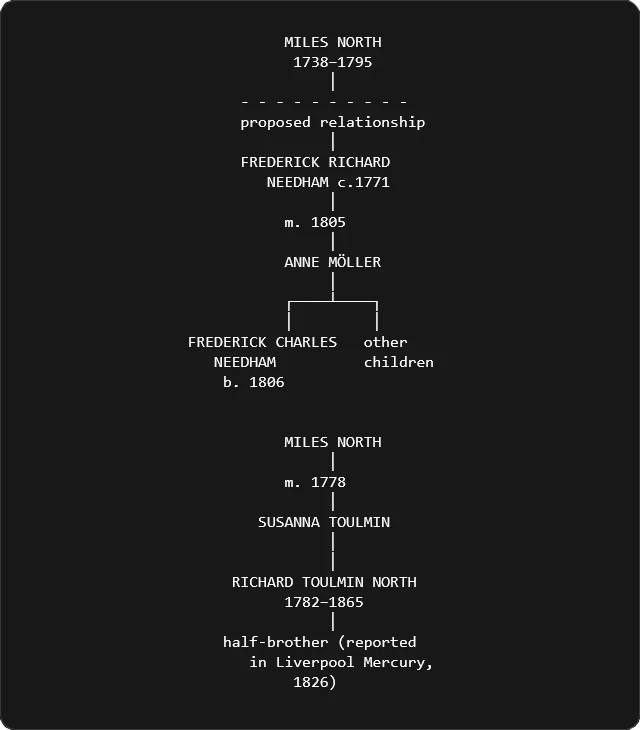
The dotted or conjectural part of this tree is the relationship between Miles North and Frederick Richard Needham, and the identification of the two Elizabeth Needhams.
The 1826 newspaper account, however, provides an independent contemporary statement that Frederick and Richard were half-brothers.
Can anyone help?
This article is being published as an appeal to other family historians, genealogists and researchers.
In particular, information would be very welcome from anyone who has encountered:
- the 1796 Irish Court of Chancery case involving Elizabeth Needham, Frederick Richard Needham and Richard Toulmin North;
- Chancery records relating to Marvelstown, County Meath, in 1796;
- papers of Miles North of Kirkby Lonsdale;
- papers of Croasdaile Molony of Dublin;
- wills or other records relating to Elizabeth Needham of Dublin;
- an inscription or other record identifying Elizabeth Needham, buried at Tunstall in 1814;
- records establishing the parentage of Rev. Frederick Richard Needham;
- further information about Frederick Needham’s education, ordination or early clerical career;
- or documentary evidence concerning the relationship between Frederick Needham and Richard Toulmin North.
The single most valuable discovery would probably be a document from the 1796 Chancery proceedings that explicitly identifies Frederick’s parentage.
Finally
What makes this investigation particularly compelling is that no single clue has to carry the entire argument.
We have an eighteenth-century will naming Elizabeth Needham and her son Frederick Richard; an Irish Chancery proceeding involving those same two people and the young Richard Toulmin North; the same North family’s Irish property; the same Irish executor; a later contemporary newspaper explicitly describing Rev. Frederick Needham as North’s half-brother; and finally a Möller marriage which connects this otherwise obscure family story to the ancestry of Henry S. Salt.
It is therefore possible that a relatively obscure piece of Irish legal history holds the key to establishing a relationship that has remained hidden behind the different surnames of Needham and North for more than two centuries.
Any information, corrections or additional sources would be very gratefully received.