

Sir Henry Marion Durand (1812–1871) was a distinguished British soldier and administrator whose career was principally spent in India. He may seem an unlikely subject for a website devoted to Henry S. Salt, whose life and work were centred on humanitarianism, animal rights, socialism and social reform.
There is, however, a close family connection.
In 1859, Durand married Emily Augusta Allnatt, daughter of Charles Blake Allnatt and Elizabeth Sophia Möller. Emily was the sister of Ellen Matilda Allnatt, Henry Salt’s mother, making Durand Henry Salt’s uncle by marriage. The Henry Salt Foundation’s family history records Emily as Henry’s aunt and godmother.
Durand and Emily had five children, including Charles Henry Marion Durand, who was born in 1860.
It is this family connection, rather than any similarity between Durand’s views and those of his nephew by marriage, that brings him into the Salt family history.
There is, however, an intriguing question surrounding Durand’s own birth.
For many years, 6 November 1812 has been given as his date of birth. It appears in modern biographical and genealogical sources and was also reproduced on the former Henry S. Salt Society website.
But there is compelling evidence for another date: 15 November 1812.
The question is therefore not simply which date has been repeated most often, but what evidence lies behind each of them.
How did the question arise?
The question of Durand’s birth date arose as part of an attempt to identify the original source for the 6 November 1812 date.
Rather than simply repeating a date found in existing genealogical and biographical sources, we wanted to establish where that date originally came from.
The search did not, so far, identify a primary document giving 6 November.
Instead, it led to something rather more unexpected: a record preserved among Durand’s Cadet Papers which points to 15 November 1812.
This was particularly significant because the document is not merely a later biography or genealogical compilation. It is a certified extract from the French civil birth register of the commune of Coulandon, in the department of Allier.
Most importantly, the document does not merely give a registration date. It explicitly states that a male child was born on 15 November 1812 at one o’clock in the morning.
The discovery prompted a closer examination of the evidence for both dates.
The two dates
The discrepancy becomes especially interesting when the existing online sources are compared.
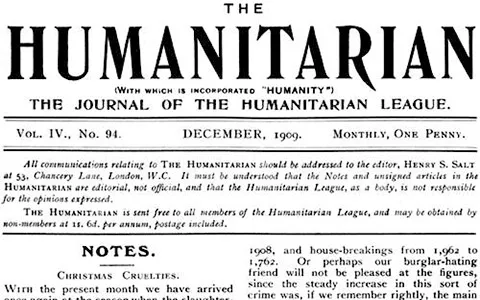
The former Henry S. Salt Society website states:
“Born 6th November 1812.”
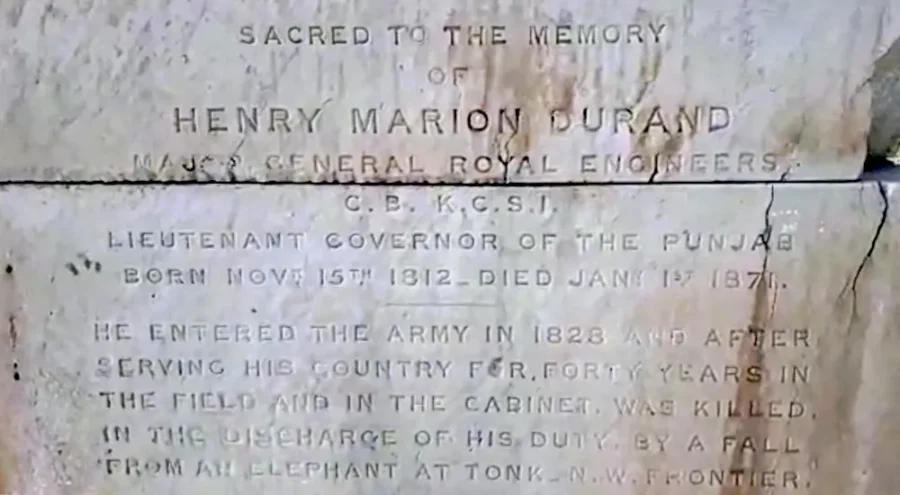
Yet on the very same page it reproduces the inscription from Durand’s tomb, which states:
“born Novr 15th 1812”
Thus, the former Society page contains an internal inconsistency: its biographical text gives 6 November, while its transcription of the tomb gives 15 November. (Henry Salt)
The date of 6 November has also continued to appear in modern secondary sources. For example, ThePeerage gives Durand’s birth as 6 November 1812, citing Burke’s Peerage for the date. (The Peerage)
The Henry Salt Foundation’s own genealogy has now been updated to 15 November 1812, following the discovery of the French civil record and the reassessment of the available evidence.
Henry Salt Foundation genealogy — Sir Henry Marion Durand
The question, therefore, is not whether 6 November has appeared in reputable sources — it clearly has. The more important question is what the original evidence for 6 November actually was.
At present, that source has not been identified.
A remarkable document from Coulandon
The most important piece of evidence discovered during this research is found in Durand’s military papers.
The British India Office records contain a file described as:
L/MIL/9/166 — Birth/baptismal certificates in Cadet Papers
The record concerns documents submitted as evidence of Durand’s age when he was seeking entry into the East India Company’s military service.
Among these papers is a certified copy of an extract from the register of births of the Commune of Coulandon, in the Arrondissement of Moulins, Department of Allier.
The document is dated 1826, but it is explicitly an extract from the 1812 civil birth register.
The crucial passage states that on 15 November 1812 at four o’clock in the afternoon, the local civil officer received a declaration from Gaspard Damerat, a 32-year-old vigneron living at Les Perrots.
He declared that Jeanne Durand, aged nineteen, had given birth to a male child:
“…né ce jour à une heure du matin…”
—that is, “born this day at one o’clock in the morning.”
The declarant further stated that the child was to be given the Christian name Marion.
This is important because it removes a possible ambiguity between a date of birth and a date of registration. The document says that the child was born on 15 November, at 1 a.m., and that the birth was declared later the same day.
In other words, the record does not merely establish that a birth was registered on 15 November. It specifically states that the child was born on 15 November 1812.
Why the wording matters
Nineteenth-century civil records can sometimes produce confusion because the date on which an event was registered is not necessarily the date on which the event occurred.
That is not the problem here.
The Coulandon record gives both times:
- the declaration was made at 4 p.m. on 15 November 1812;
- the child was stated to have been born at 1 a.m. that same day.
The distinction is therefore explicit.
The relevant passage reads:
“…Jeanne Durand, age de dix-neuf ans, demeurant aux Perrots, est accouchée d’un enfant mâle, né ce jour à une heure du matin…”
The record consequently provides unusually direct evidence for 15 November 1812.
The certificate was later formally certified
The document in Durand’s Cadet Papers is not simply an informal family note.
A certified copy was issued at Coulandon on 20 October 1826, approximately fourteen years after the birth. It was signed by the mayor, Vidalin.
The copy was then further certified at the Tribunal of First Instance at Moulins on 23 October 1826.
This is significant because Durand was apparently using the documentation as evidence of his age for official purposes.
The document therefore represents a formal nineteenth-century record derived from the original French civil register, rather than a date appearing for the first time in a much later genealogical work.
The tomb gives the same date
There is another piece of evidence pointing to 15 November: Durand’s tomb.
The monument is at St Thomas’s Church, Dera Ismail Khan, and its inscription reads:
“Sacred to the memory of Henry Marion Durand Major General Royal Engineers C.B. K.C.S.I. Lieutenant Governor of the Punjab. born Novr 15th 1812 – died Jany 1st 1871.”
The former Henry S. Salt Society website itself reproduces this inscription, despite giving 6 November in its biographical text. (Henry Salt)
The agreement between the tomb and the French civil record is certainly striking.
There is, however, an important qualification.
We cannot yet establish that the tomb inscription represents independent evidence.
It is possible that information about Durand’s birth was taken from family or official papers — potentially including the very documentation now found among his Cadet Papers. If so, the tomb and the French certificate would ultimately derive from the same source.
For that reason, it would be premature to describe the two as two completely independent contemporary confirmations.
Nevertheless, the tomb is significant because it demonstrates that 15 November was an established date associated with Durand during his lifetime or shortly afterwards, rather than a date invented by the present-day Foundation.
Where did 6 November come from?
This is perhaps the most interesting unanswered question.
The date 6 November 1812 has a substantial presence in modern secondary sources. It is found in biographical and genealogical material, including ThePeerage and other modern accounts. (The Peerage)
Yet the research undertaken so far has not located an original nineteenth-century document that actually says 6 November.
The former Henry S. Salt Society website gives 6 November in its biographical text, but simultaneously reproduces the tomb inscription giving 15 November. (Henry Salt)
This raises an obvious possibility: 6 November may be the result of an earlier transcription, genealogical error, or subsequent repetition of an undocumented date.
But at present that remains a possibility rather than a demonstrated fact.
It is also possible that a document giving 6 November exists and simply has not yet been located.
That is why the Foundation’s research remains open.
An interesting clue: Jeanne Durand and “Marion”
The French birth record raises another intriguing genealogical question.
The mother named in the Coulandon record is:
Jeanne Durand, aged nineteen.
The child was to be given the Christian name Marion.
This is interesting because British accounts of Durand’s parentage traditionally identify his mother as Marion Durand, a French woman with whom Lieutenant-Colonel Henry Percy formed a relationship while he was a prisoner of war in France.
Modern accounts describe Percy as having had two illegitimate sons with a French woman, one of whom became Sir Henry Marion Durand. (Wikipedia)
There is consequently an intriguing possibility that the woman subsequently remembered in British sources as Marion Durand was the Jeanne Durand named in the French civil record, with “Marion” perhaps becoming associated with her or being used as the child’s name.
However, this should not currently be stated as an established identification.
The French record clearly says Jeanne Durand, while later British sources call the mother Marion Durand. Establishing whether these names refer to the same woman will require further research into French records and the circumstances of Percy’s imprisonment.
There is an additional reason for caution here. ThePeerage states that Henry Percy married Marion Durand, but its citation for that marriage is a 2009 genealogical email rather than the Burke’s Peerage source cited for other details. (The Peerage)
Other historical accounts instead state that Percy never married, but had two illegitimate sons with a French woman while he was a prisoner in France. (Wikipedia)
This is a separate genealogical problem which deserves investigation in its own right.
It may also provide another avenue for identifying the original source of Durand’s birth information.
Does this settle the birth date?
On the evidence currently available, 15 November 1812 is the better-supported date.
The principal reason is the French civil record from Coulandon. It is a certified extract from the original register and explicitly states that a male child was born on 15 November 1812 at one o’clock in the morning.
The tomb inscription independently gives the same date, although we cannot yet establish whether the inscription was based on the same documentary tradition.
Against this stands the well-established secondary tradition of 6 November 1812.
The difficulty is that, despite its repeated appearance in modern sources, the original evidence for 6 November has not yet been found.
It would therefore be too strong to say that the question is completely settled.
A more accurate conclusion is:
The evidence currently available favours 15 November 1812 as the date of birth of Sir Henry Marion Durand. The date is supported by a certified extract from the French civil birth register of Coulandon and by the inscription on Durand’s tomb. However, the original source of the traditionally cited date of 6 November 1812 has not yet been identified, and further evidence may yet clarify the discrepancy.
As a result of this research, the Henry Salt Foundation’s genealogy has been updated to 15 November 1812.
An invitation to further research
One of the purposes of publishing this investigation is not simply to replace one date with another, but to make the evidence and the reasoning behind the change available to other researchers.
The discovery of the Coulandon record demonstrates the value of going back beyond modern genealogical compilations and asking a deceptively simple question:
Where did the date actually come from?
In this case, the attempt to establish the source of 6 November led instead to a primary record giving 15 November.
That does not necessarily mean that the story ends there.
Researchers may be aware of:
- an earlier biography of Durand which gives 6 November;
- family papers or correspondence referring to his birth;
- British military records containing a different date;
- French civil or church records which might shed further light on the family;
- records relating to Henry Percy and Jeanne/Marion Durand;
- or another early source from which the 6 November date can be traced.
If such evidence exists, the Foundation would be very interested to hear about it.
For the present, however, 15 November 1812 should be regarded as the date supported by the strongest primary evidence located so far.
Appendix A — Working transcription of the French birth record
The following is a working transcription of the French extract preserved in Durand’s Cadet Papers. The handwriting and reproduction make some personal names difficult to read with complete certainty; uncertain readings are therefore indicated where appropriate.
Extrait du registre des actes de naissance de la Commune de Coulandon pendant l’année 1812.
L’an mil huit cent douze, le quinze novembre à quatre heures du soir, devant nous Maire faisant les fonctions d’Officier de l’état civil de la Commune de Coulandon, arrondissement de Moulins, département de l’Allier,
a comparu Gaspard Damerat [reading of surname uncertain], âgé de trente deux ans, vigneron, demeurant aux Perrots, en ladite Commune, lequel nous a déclaré que Jeanne Durand, âgée de dix-neuf ans, demeurant aux Perrots, est accouchée d’un enfant mâle, né ce jour à une heure du matin et auquel il a déclaré vouloir donner le prénom de Marion ;
ladite déclaration faite en présence de Gilbert Dechaume, âgé de cinquante ans, cultivateur au Domaine des Perrots ; et de Jean Dechaume, âgé de trente deux ans, cultivateur au même lieu ;
et les comparant et témoins, après lecture faite du présent acte, ont déclaré ne savoir signer.
[Signé] Deligonde, Maire.
Pour copie conforme à Coulandon le vingt octobre 1826.
[Signé] Vidalin, Maire.
There is a further certification from the Tribunal de Première Instance de Moulins, dated 23 October 1826.
A note on the transcription
This should be regarded as a working transcription rather than a definitive diplomatic edition. In particular, the surname of the declarant and some of the names in the administrative certifications would benefit from comparison with the original register or a higher-resolution image.
For the purposes of the present investigation, however, the crucial wording is unambiguous:
“le quinze novembre”
and
“né ce jour à une heure du matin”
Together these explicitly place the birth on 15 November 1812.
Appendix B — English version preserved with the record
An English rendering of the French extract is also preserved among the documents.
Extracted from the Register of Births of the Commune of Coulandon during the year 1812.
In the year one thousand eight hundred and twelve, the fifteenth of November, at four o’clock in the evening, before us Mayor, acting as Officer of the Civil State, of the Commune of Coulandon, Arrondissement of Moulins, Department of L’Allier,
has appeared Gaspard Damerat, aged thirty two years, wine-grower, living at the Perrots, in the said Commune, who has declared to us that Jeanne Durand, aged nineteen years, living at the Perrots, is delivered of a male child, born this day at one o’clock in the morning, and to which he has declared to wish to give the Christian name of Marion;
the said declaration made in the presence of Gilbert Dechaume, aged fifty years, farmer in the Domaine of the Perrots; and of Jean Dechaume, aged thirty two years, farmer of the same place;
and both the deponent and witnesses, being asked, have declared not being able to sign, after the reading of the said act to them.
(Signed) Deligonde, Mayor.
In exact copy issued at Coulandon, the twentieth of October 1826.
(Signed) Vidalin, Mayor.
This English text appears to be a historical rendering preserved with the record rather than a modern translation prepared for this article. Consequently, the French original should be regarded as the authority.
Appendix C — Summary of the evidence
| Evidence | Date given | Nature of evidence | Assessment |
|---|---|---|---|
| French civil birth record, Coulandon | 15 November 1812 | Certified extract from original civil register | Strong primary evidence |
| French record — time of birth | 1 a.m., 15 November 1812 | Explicit statement within birth record | Direct evidence of date of birth |
| Durand’s Cadet Papers, L/MIL/9/166 | 15 November 1812 | Official documentation submitted as evidence of age | Strong documentary evidence |
| Tomb inscription, St Thomas’s Church, Dera Ismail Khan | 15 November 1812 | Contemporary/near-contemporary memorial inscription | Important corroboration, but independence uncertain |
| Former Henry S. Salt Society biography | 6 November 1812 | Modern secondary website | Secondary evidence |
| Former Society transcription of tomb | 15 November 1812 | Transcription of physical monument | Supports 15 November |
| ThePeerage | 6 November 1812 | Modern genealogical compilation | Secondary evidence; source ultimately needs tracing |
| Other modern biographical sources | 6 November 1812 | Secondary/tertiary sources | Repeated tradition, but original source not established |
The key distinction is therefore between repetition and provenance.
The fact that 6 November occurs in several modern sources does not necessarily mean that those sources represent several independent pieces of evidence. They may ultimately descend from a single earlier source.
Conversely, the Coulandon record provides a direct documentary statement of the date of birth.
Sources and further reading
Primary and near-primary sources
British India Office Records, British Library
L/MIL/9/166 — Birth/baptismal certificates in Cadet Papers.
This is the principal documentary source discussed in this article. It contains the certified extract from the Coulandon civil birth register.
Civil birth register of the Commune of Coulandon, 1812
The extract preserved in Durand’s Cadet Papers records the birth of a male child to Jeanne Durand and states that he was born on 15 November 1812 at 1 a.m.
Tomb of Sir Henry Marion Durand, St Thomas’s Church, Dera Ismail Khan
The inscription gives his birth date as 15 November 1812.
Henry Salt Foundation resources
Henry Salt Foundation — Sir Henry Marion Durand
Henry Salt Foundation — Genealogy: Sir Henry Marion Durand
Henry Salt Foundation — Charles Blake Allnatt
Henry Salt Foundation — Elizabeth Sophia Möller / Allnatt
Former Henry S. Salt Society resource
Former Henry S. Salt Society — Sir Henry Marion Durand
This page is particularly relevant because it contains both elements of the discrepancy discussed in this article: the biographical text gives 6 November 1812, while its transcription of Durand’s tomb gives 15 November 1812. (Henry Salt)
Genealogical and secondary sources
ThePeerage — Lt-Col. Hon. Henry Percy
ThePeerage gives Henry Percy as the father of Sir Henry Marion Durand and gives Durand’s birth as 6 November 1812. It also states that Percy married Marion Durand, although the site’s citation for that marriage is a later genealogical email rather than the Burke’s Peerage citation used for other details. (The Peerage)
ThePeerage — Marion Durand
ThePeerage separately records a woman named Marion Durand as Henry Percy’s wife and mother of Henry Marion Durand. (The Peerage)
Burke’s Peerage, Baronetage and Knightage, 2003
ThePeerage cites Burke’s Peerage as its source for the 6 November date. The underlying source should ideally be consulted directly as part of any future attempt to establish where that date originated.
William Mahon, Waterloo Messenger: The Life of Henry Percy, Peninsular Soldier and French Prisoner of War
This work provides useful background for the relationship between Henry Percy and the French woman traditionally known as Marion Durand, and may offer further clues for research into the Durand family’s French origins.
A final note
Genealogical research often progresses not by immediately finding the answer, but by discovering that the question is more complicated than it first appeared.
In this case, the starting point was a familiar date — 6 November 1812 — and a straightforward attempt to discover its original source. That search instead uncovered a certified French civil record explicitly recording a birth on 15 November 1812.
The evidence now available therefore gives us good reason to use 15 November 1812, while retaining the earlier date as an unresolved part of the documentary history.
For the Henry Salt Foundation, that distinction is important. The purpose of genealogical research is not simply to replace an old date with a new one, but to show why the evidence has led us to revise our understanding — and to leave the door open for further evidence.
If any reader can identify an early or original source for the 6 November 1812 date, or has additional evidence concerning Durand’s birth in Coulandon, the Foundation would be very pleased to hear from them.