

Lady Durand (Emily Augusta Allnatt) (1832–1905)
Emily Augusta Allnatt was the daughter of Charles Blake Allnatt, a barrister of Shrewsbury, and his wife, Elizabeth Sophia Möller. She was the sister of Ellen Matilda Allnatt, the mother of Henry Salt, and became one of the most notable members of the Allnatt family through her experiences during the Indian Mutiny of 1857.
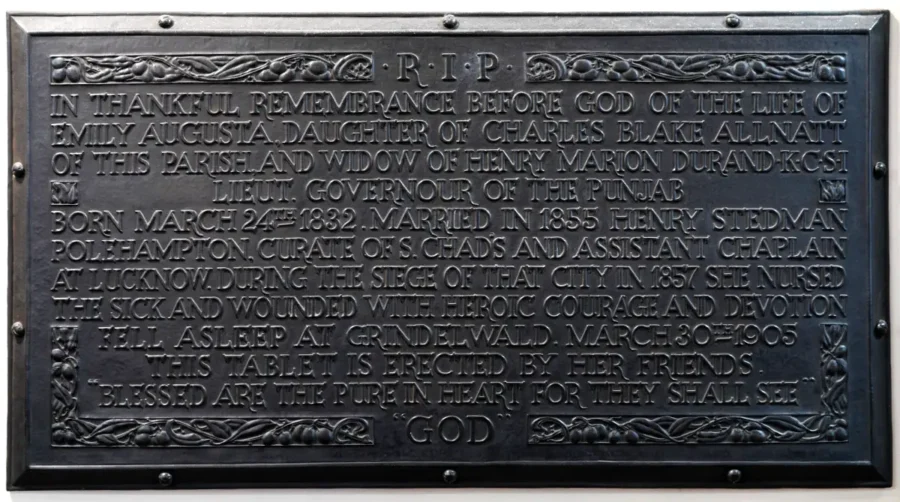
On 10 October 1855, Emily married the Reverend Henry Stedman Polehampton at St Chad’s Church, Shrewsbury. He had accepted a chaplaincy with the East India Company and was appointed chaplain to the garrison at Lucknow. The couple sailed for India in January 1856, and their son, Henry Allnatt Polehampton, was born at Lucknow in December that year. The infant died in January 1857.
When the Indian Mutiny reached Lucknow in the summer of 1857, Emily and her husband took refuge within the British Residency, where the garrison and civilian population endured a prolonged siege. Emily volunteered as a nurse, caring for the sick and wounded under extremely difficult conditions. Her husband was wounded by a stray shot on 8 July and died on 20 July 1857, after developing cholera.
Emily survived the siege and was eventually evacuated from Lucknow. Her experiences, including the loss of her husband and infant son, formed part of the published account of the Reverend Polehampton’s life and letters. Her courage and devotion to the sick and wounded became an enduring part of her reputation.
On 23 August 1859, Emily married, secondly, Sir Henry Marion Durand, the distinguished soldier, civil servant and diplomat who later served as Lieutenant-Governor of the Punjab. Through this marriage she became Lady Durand. They had five children: Charles Henry Marion, Reginald, Ethel, Isabel and Muriel. Isabel died in infancy; Ethel later married James Sligo Jameson and, following his death, Roberto, Conte di Villamarina. Muriel never married. Emily also became stepmother to Durand’s sons from his first marriage, including Sir Edward Law Durand and Sir Henry Mortimer Durand, both of whom pursued distinguished careers.
Emily outlived her second husband, who died in 1871, by more than thirty years. She died at Grindelwald, Switzerland, on 30 March 1905, according to genealogical records.
Her life is commemorated by a memorial tablet in St Chad’s Church, Shrewsbury, the church where she married her first husband. The inscription remembers her as the daughter of Charles Blake Allnatt and widow of Sir Henry Marion Durand, and pays tribute to the courage and devotion she showed while nursing the sick and wounded during the siege of Lucknow.
THE LATE LADY DURAND TRIBUTE
To the Editor of the Advertiser.
SIR,—The cursory notice in the various daily papers of the death of the late Lady Durand, resident in the parish of St. Leonards for many years, is wholly inadequate to the loss sustained by all who knew her.
Lady Durand was a singular combination of intellectual power and the sweet beauty of childlikeness.
She married early in life the Rev. Edward Polehampton, British Chaplain at Lucknow, and went through all the vicissitudes of the Indian Mutiny. On losing her husband during that terrible time, Lady Durand turned her mind to helping the wounded and suffering, and worked nobly in the Lucknow Hospital, where she was actually shot by a native when helping to carry a suffering soldier from one ward to another, the mark of which was apparent to the close of her life.
Some years afterward she married Sir Henry Durand, C.B., K.C.S.I., R.E., Governor of the North Western Provinces, whose untimely death at a Durbar was enough to crush the bravest spirit.
On Lady Durand’s return to England, she took up her residence in this town, and spent the greater part of her time in intellectual pursuits. Her knowledge of Hebrew was sufficient to allow her to translate the Psalms from the original, and the writer of these lines believes she was an equally good Greek scholar, while it is known that her translations of many German hymns into English verse shows the touch of a highly cultured mind and the true insight of a refined nature.
The bent of Lady Durand’s study was towards theology, and the great old Catholic preacher, Père Hyacinthe, was a frequent guest at her house, and deep was the interest his hostess took in his work.
I cannot finish this short notice without alluding to the sympathetic charm of Lady Durand’s personality. She was naturally of a shy nature, which made it somewhat difficult for the few to grasp her charms, but none who knew that stately, beautiful personality could fail to be struck by her winsomeness, or enjoy the strong vein of humour, or be soothed or calmed when in difficulties or sorrows.
On leaving St. Leonards, Lady Durand went to live in Switzerland, and took up her abode at Grindelwald with her only unmarried daughter, who was her constant and devoted companion. There her life was uniform and occupied, which doubtless prolonged it, until she quietly passed away in her sleep to begin that higher life for which she daily prepared.
May I be allowed, with many others, to offer our deep sympathy to the family in this their sorrowful loss, a loss shared in to some degree by all who knew the late Lady Durand?
Yours truly,
A.G.T.
Published: Hastings St Leonards Advertiser, April 6, 1905, page 7.